
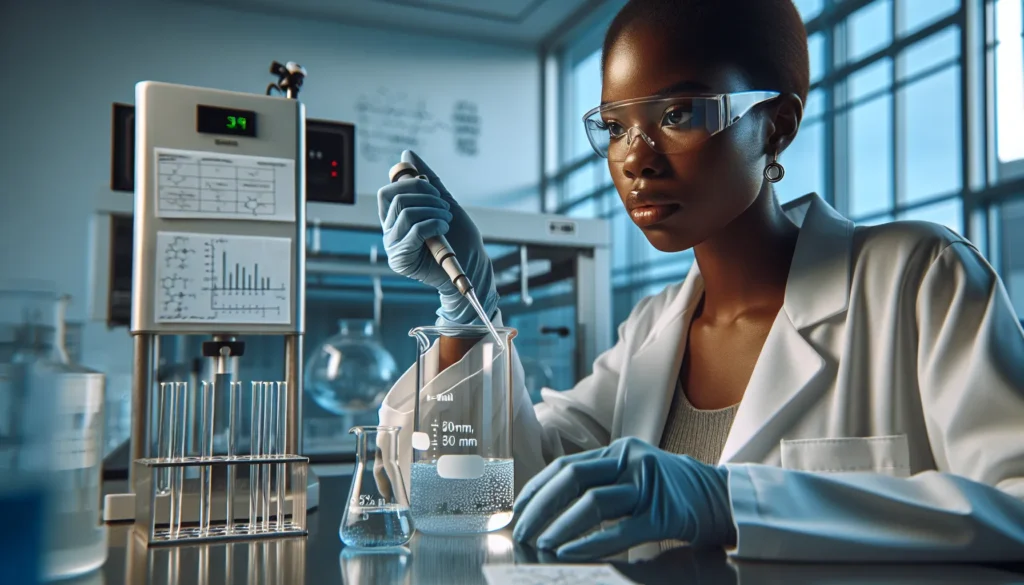
I still remember the first time I asked in lab, “So what is a buffer in biology, exactly?” The answer seemed simple, until I watched an enzyme assay fall apart because the pH wandered off by a few tenths. In living systems, small pH shifts can have big consequences. In this guide, I’ll keep the chemistry friendly and practical: what buffers are, how they work, where they show up in the body, and how I choose and use them in the lab without inviting pH headaches.
Key Takeaways
- A buffer in biology is a weak acid/base conjugate pair that resists pH changes by neutralizing added acids or bases.
- When choosing a buffer in biology, match the buffer’s pKa to your target pH within ±0.5 and use the Henderson–Hasselbalch relationship to set the acid:base ratio.
- Know the difference between buffer range (pKa ±1) and buffer capacity (which rises with concentration but isn’t automatically better for biology), and remember dilution lowers capacity without changing the set pH until components deplete.
- Control experimental conditions: temperature shifts pKa (e.g., Tris ~0.028 pH/°C), ionic strength alters activity, and CO2 uptake or contamination can drift pH, so adjust and verify at working temperature.
- Major biological buffers include the bicarbonate system for blood (~pH 7.35–7.45), intracellular phosphate near neutrality (avoid with Ca2+/Mg2+), and protein/hemoglobin histidine buffering.
- Favor Good’s buffers (MES, PIPES, MOPS, HEPES) for low interference, and watch incompatibilities like phosphate+Ca2+/Mg2+ precipitates, Tris–aldehyde reactivity and temperature sensitivity, HEPES light sensitivity, and EDTA stripping metal cofactors.
Why pH Stability Matters in Living Systems
Enzyme Activity and Protein Structure
Enzymes are picky. Their active sites rely on the right ionization states, often of histidine, lysine, cysteine, or acidic residues, to catalyze reactions efficiently. A 0.3–0.5 pH unit shift can slow an enzyme dramatically, sometimes by an order of magnitude. And it’s not just catalysis. Protein structure depends on ionic interactions and hydrogen bonds that are sensitive to pH. Nudge the charge pattern and you can alter folding, aggregation, or binding. I’ve seen an enzyme go from hero to zero just by drifting from pH 7.4 to 6.9 over a long incubation.
Cellular Compartments and pH Gradients
Cells run on gradients. Lysosomes live around pH 4.5–5 to power acid hydrolases. The mitochondrial proton gradient couples electron transport to ATP synthesis. The cytosol hovers near pH ~7.2, while the ER and Golgi tweak pH to control trafficking and processing. Buffers (intrinsic and added) help keep these micro-environments stable so signals, transporters, and enzymes all stay in tune.
What Is a Buffer? A Clear Definition
Weak Acid–Base Conjugate Pairs
At its core, a buffer is a solution that resists pH changes when small amounts of acid or base are added. Practically, that means a weak acid (HA) and its conjugate base (A−), or a weak base and its conjugate acid, are both present. When acid arrives, A− soaks up H+. When base arrives, HA donates H+ to neutralize it. This reversible give-and-take is the cushion that protects pH.
Buffer Range Versus Buffer Capacity
Two ideas keep me honest:
- Buffer range: where a buffer holds pH well, roughly pKa ± 1 pH unit.
- Buffer capacity: how much strong acid/base the buffer can absorb before the pH moves, this scales with total buffer concentration and the HA:A− ratio. Higher concentration means more capacity, but not automatically “better” for biology: you still need compatibility with your system.
How Buffers Work: The Chemistry Made Simple
Neutralizing Added Acids and Bases
It’s Le Châtelier in action. Add a bit of strong acid (H+), and the conjugate base (A−) converts to HA, buffering the blow. Add strong base (OH−), and HA donates H+ to form water, becoming A−. Because both partners are present, the pH hardly budges until one partner gets depleted.
Henderson–Hasselbalch and pKa Matching
The Henderson–Hasselbalch relationship puts numbers on this: pH depends on pKa and the ratio of base to acid. I pick buffers whose pKa is close to my target pH, ideally within 0.5 units. At pH = pKa, HA and A− are equal, and buffering is strongest against both acid and base. Need pH 7.4? HEPES (pKa ~7.5 at room temp) or MOPS (pKa ~7.2) are common choices: phosphate (second pKa ~7.2) also works, with caveats around metal precipitation.
Effects of Dilution, Temperature, and Ionic Strength
- Dilution: lowers buffer capacity, not the set pH (until you start to deplete one partner during the experiment).
- Temperature: shifts pKa. Tris, for instance, changes ~0.028 pH/°C, warm it by 10°C and you’re ~0.28 pH units off. I always adjust pH at (or near) the working temperature.
- Ionic strength: changes activity coefficients and can tweak observed pH and enzyme behavior. Matching ionic strength to physiological conditions (or your assay’s norm) saves headaches.
Major Biological Buffer Systems
Bicarbonate–Carbonic Acid in Blood
Blood’s big player is the bicarbonate system: CO2 + H2O ↔ H2CO3 ↔ H+ + HCO3−. Carbonic anhydrase speeds the CO2–H2CO3 step. With a pKa around 6.1 and CO2 exchange via the lungs plus HCO3− handling by kidneys, this “open” buffer tightly regulates pH ~7.35–7.45. Clinically, the Henderson–Hasselbalch form uses [HCO3−] and dissolved CO2 (proportional to pCO2), which is why ventilation changes can swing blood pH.
Phosphate Buffer in Cells
Inside cells, inorganic phosphate (H2PO4−/HPO4^2−) helps stabilize cytosolic pH near neutrality. The second dissociation has a pKa ~7.2 at 25°C, making phosphate a solid intracellular buffer. It’s cheap and effective for many assays, but in extracellular solutions it can precipitate with Ca2+ and Mg2+, so I avoid it when I’m working with high calcium or live cells that need clean ion homeostasis.
Protein and Hemoglobin Buffers
Proteins, especially those rich in histidine, soak up or release protons across physiological pH. Hemoglobin is a star: deoxygenated Hb binds protons better (the Bohr effect), which helps shuttle CO2 as bicarbonate and buffer blood during oxygen delivery. It’s a beautiful coupling of gas transport and pH control.
Choosing, Preparing, and Using Buffers in the Lab
Selecting pKa, Concentration, and Ionic Strength
My quick checklist:
- Target pH within ±0.5 of the buffer’s pKa.
- Concentration high enough for capacity (10–100 mM is common), but not so high that it perturbs your system.
- Ionic strength compatible with your assay or cells: add salts thoughtfully.
- Low interference: does the buffer bind metals, absorb light, fluoresce, or react with reagents?
Preparing with Acid/Base Pair or Titration
I usually dissolve the conjugate acid or base, then titrate to the target pH with the complementary partner (or NaOH/HCl). Calibrate the pH meter freshly, use CO2-minimized water if carbonate-sensitive, and adjust at the temperature you’ll use. One practical tip: approach the pH from the same direction every time (always titrate up, for instance) for consistent results.
Good’s Buffers and When to Use Them
Good’s buffers (HEPES, MES, MOPS, PIPES, and friends) were designed for biology: minimal metal binding, low membrane permeability, modest temperature coefficients, and little reactivity. I reach for MES around pH 6.0–6.5, PIPES/MOPS near 6.8–7.2, and HEPES around 7.2–7.8, especially for live cells or fluorescence work where phosphate or Tris might interfere.
Applications, Limitations, and Troubleshooting
Enzyme Assays, Molecular Biology, and Cell Culture
Enzyme assays live and die by pH. I pilot conditions in two or three buffers to check for buffer-specific effects. In molecular biology, Tris-based buffers (like TE) are common, with EDTA to chelate metals that drive nuclease activity. In cell culture, bicarbonate/CO2 systems maintain pH in the incubator: HEPES can add extra stability when cultures spend time outside.
CO2 Absorption, Contamination, and pH Drift
Open beakers and vigorous stirring invite CO2 from the air, which can slowly acidify solutions, noticeable with carbonate-sensitive buffers and during long experiments. Microbial contamination also drives pH down as cells metabolize. I keep containers capped when possible, minimize headspace, and verify pH after long incubations. More than once I’ve caught a 0.2–0.3 unit drift that explained a weird data blip.
Incompatibilities with Metals, Detergents, or Reagents
- Phosphate + Ca2+/Mg2+: can form precipitates (the dreaded cloudy “snowstorm”).
- Tris: significant temperature coefficient and can interact with aldehydes (it complicates formaldehyde fixation) and some enzyme metal sites.
- HEPES: great for cells, but under strong light it can generate reactive species: I keep light exposure modest during imaging.
- EDTA in buffers: fantastic to inhibit nucleases, but it will strip needed metal cofactors from enzymes if you forget it’s there.
Choosing buffers with the whole experiment in mind saves a lot of “why is this sample cloudy?” moments.
Conclusion
So, what is a buffer in biology? It’s the quiet stabilizer, chemically poised to catch stray acids and bases so life can get on with the interesting stuff. When I match pKa to target pH, set a sensible concentration, and respect temperature and compatibility, my experiments are calmer and my data cleaner. Build that habit, and pH becomes one of the most predictable parts of your day.
Frequently Asked Questions
What is a buffer in biology, and how does it work?
A buffer in biology is a solution that resists pH change by pairing a weak acid with its conjugate base (or vice versa). When acid or base is added, one partner neutralizes it. Using the Henderson–Hasselbalch relationship, you match pKa to target pH so both partners are present.
What’s the difference between buffer range and buffer capacity?
Buffer range is the pH window where a buffer works best, roughly pKa ±1 unit. Buffer capacity is how much strong acid or base it can absorb before pH shifts, scaling with total concentration and the acid:base ratio. Higher capacity isn’t always better—excessive buffer can perturb biological systems.
Which buffer in biology should I choose for pH 7.4?
For pH ~7.4, common choices include HEPES (pKa ~7.5), MOPS (~7.2), or phosphate (second pKa ~7.2). Each buffer in biology has trade‑offs: phosphate can precipitate with Ca2+/Mg2+, while Good’s buffers like HEPES minimize metal binding and fluorescence interference, making them popular for live cells and imaging.
How do temperature, dilution, and ionic strength affect buffer pH?
Dilution lowers buffer capacity but not the set pH until one component is depleted. Temperature shifts pKa—Tris changes about 0.028 pH per °C, so adjust at your working temperature. Ionic strength alters activity coefficients and enzyme behavior; match salt levels to physiological or assay conditions for consistent results.
Can I use HEPES with bicarbonate/CO2 in cell culture?
Yes. Many labs combine 10–25 mM HEPES with a bicarbonate/CO2 system to stabilize pH during handling outside the incubator, then rely on 5% CO2 in culture. Calibrate pH at 37°C under CO2. Limit intense illumination, since HEPES can promote reactive species under strong light during imaging.
How long do biological buffers last, and how should I store them?
Most biological buffers are stable for weeks to months if sterile‑filtered, stored at 4°C, and kept tightly capped to limit CO2 uptake. Avoid repeated warming/cooling, and discard if cloudy or precipitated. For sensitive work, prepare fresh or aliquot. Verify pH before use, especially after long storage.